Relay Assistant - Support
After the success of the Negotitions chatbot, product and engineering leadership showed interest in the concepts I had developed earlier. The project team got funding to automate some of the support use cases that were being handled manually, took hours if not days to resolve that led to major dissatisfaction among the carriers.
(To maintain confidentiality, I have included visuals that did not launch, but give an idea about my skills and my role as a designer.)
Project Overview
Customers
Our customers are carriers- trucking companies and owner-operators approved to haul freight for Amazon through the Relay for Carrier platform, which connects carriers directly with Amazon’s load board and contracts without third-party intermediaries
Opportunity
he ‘Help and Support’ experience on Relay for Carrier consistently had low CSAT ratings, and led to a lot of delays in resolving carrier issues, which in turn impact our delivery promises to the customers buying goods on Amazon. Automating some of these tasks could save time and money for the business, and effort for the carriers.
Goals
The goal of this project was to start small and tackle the most frequent questions that carriers call Amazon about, and scale to complex use cases that required cross-organizational coordination
Identifying use cases for automation
Before

For a simple use case like checking status of an upcoming trip, carriers needed to fill a form, and then wait for someone to call them back. While I can’t share exact numbers, this use case had the highest volume of callbacks. It was also the easiest to solve for the tech team since our back-end had the data, we only needed to surface it when necessary. Displaying it by default would cause a lot of latency, and that’s another reason why a chat interface was helpful. Carriers could ask, and only then would our API ping our back-end.
After
Relay Assistant can now give you a status update in chat, and allow carriers to make changes like cancel their trip if their schedules have changed. Sharing lo-fidelity Figma prototypes like the one below helped stakeholders visualize the speed of resolving simple use cases. It also provided tech partners a visual during feasibility and scoping exercises.
Identifying ingress points
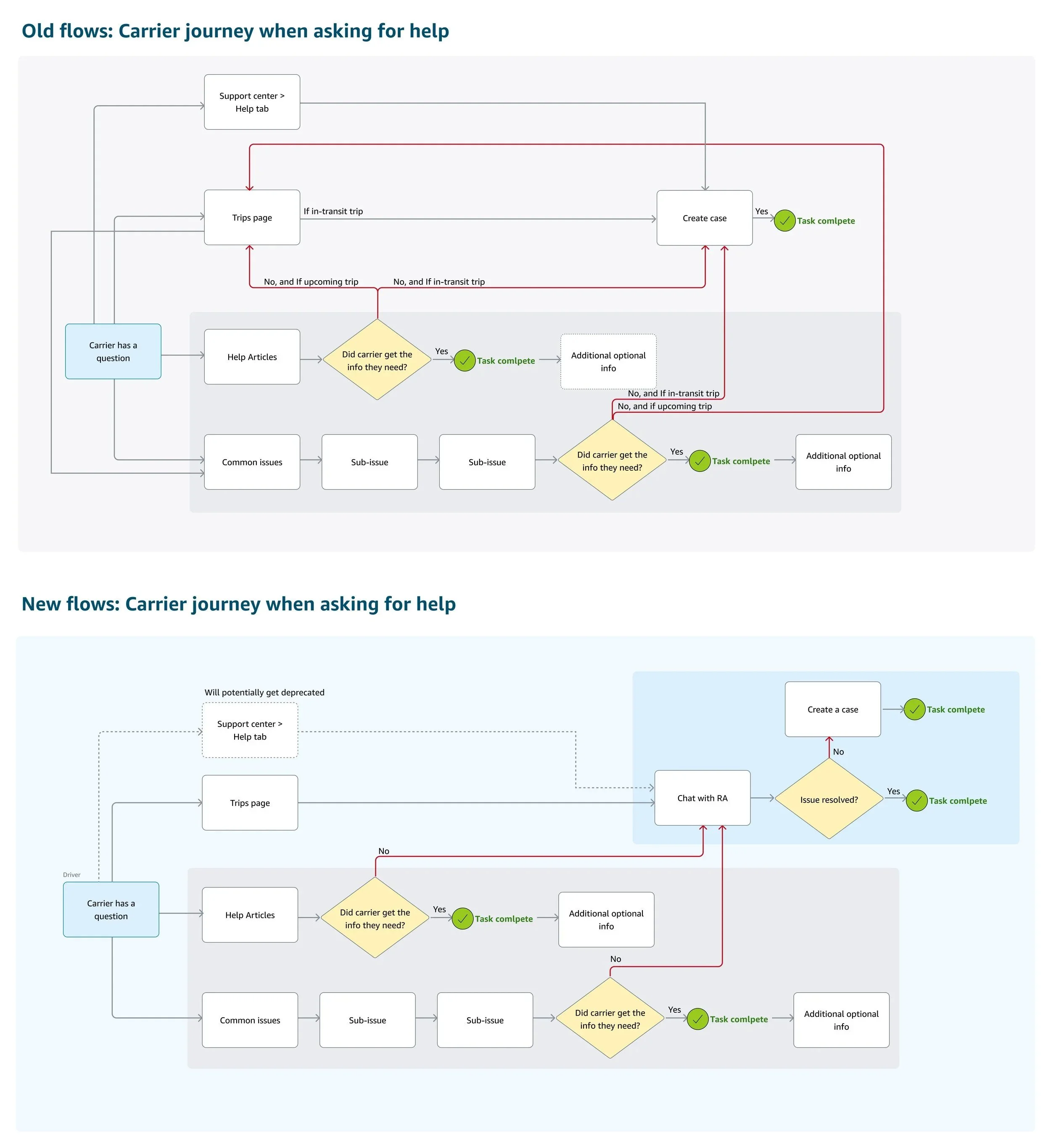
The old experience had help and support articles and pages scattered across the platform. Carriers could read FAQs and Help articles from anywhere in their journey on the platform. Our data showed that carriers liked having contextual support, so my recommendation was to provide an ingress to chat support in multiple places to get carriers used to the new mental model. This approach also provided an opportunity for tech teams to deprecate old experiences in a phased manner. Mapping out flows helped visualize how we would meet carriers where they were.
Building a framework
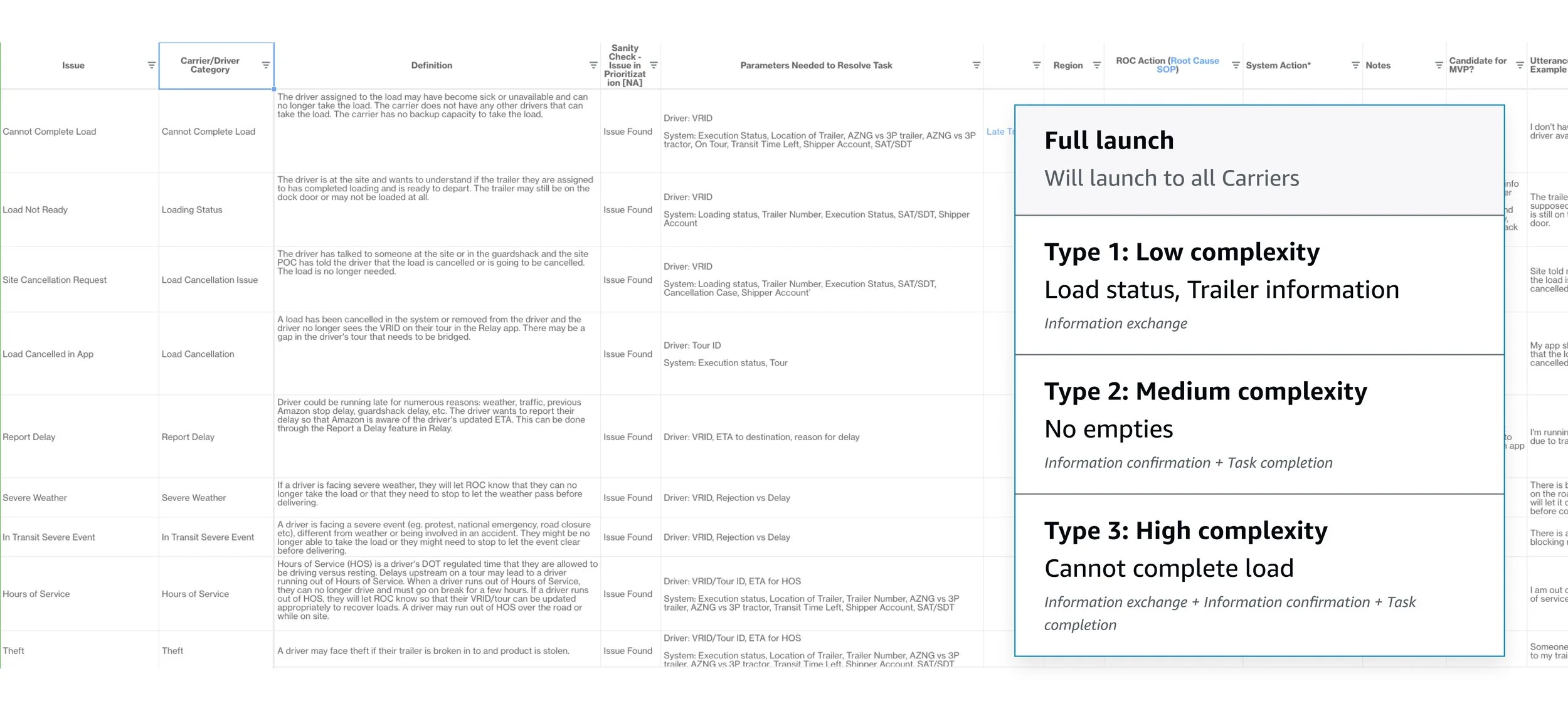
Example of a Medium Complexity flow
Key Highlights:
Contextual ingress
Context-aware information in chat
Task completion
Guiding conversation back to the task when bot is unable to answer a question
Usability testing showed promising results and carriers loved the ease of getting answers without needing to navigate through decision trees, forms and multiple dead ends. It was now time to go beyond answering questions; and move towards automating resolutions for carriers. While the tech team was thinking and exploring frameworks for agents to solve these different types of problems, I was exploring ways to classify problems based on their level of complexity. Higher the complexity, greater the risk of latency and a bad carrier experience. We defined complexity based on the number of actions that a carrier needed to take, the kind of information and data our back end needed to access to complete the action on behalf of the customer and the level of autonomy carriers would want with these actions. We ended up with 3 types of complexities after reviewing hundreds of carrier conversation transcripts.
How did we measure success?
Time Savings
“Everything is good! I just wanted to say how MUCH I love the “Load Status” feature of the Relay Assistant!!! Awesome, Awesome, Awesome!”
~x00K ROC minutes saved each week
(Exact numbers cannot be revealed due to confidentiality)
Reduction in manual support
y0% reduction in manual support tasks per executed load YoY
(Exact numbers cannot be revealed due to confidentiality)
Customer delight
Carriers now receive instant resolutions for over z0% of support contacts in a language of their choice.